
When a toilet will not clear and the drain outside is full, the blockage is either in the pan, in the pipe between the toilet and the chamber, or further along the drain, and the drain on your side of the boundary is yours to deal with. Lift the chamber lid nearest the house, look from above without climbing in, and read the water: standing water means the blockage is further along towards the boundary, and a dry channel means it is between that chamber and the toilet. Do that before anyone is booked, because MyJobQuote's page of 22 September 2026 puts clearing at the pan at £75 to £100 and rodding the outside drain at £100 to £150, and paying for the first when you needed the second means paying twice. This guide pairs what the toilet is doing with what the chamber shows, gives a worked example with the sums, says where a householder should stop and lists what a fair quote contains. If you would rather hand it over, our drain unblocking service covers Alloa, Falkirk, Stirling and the rest of Central Scotland.
First: is it the toilet or the drain?
A chamber reading only makes sense once you know whether the toilet is the only fitting affected. Scottish Water says the drain that runs from a house to the public sewer is usually about four inches wide and is designed to take used water from sinks, showers and baths plus pee, poo and toilet paper. Every fitting in the house feeds into that one pipe, so the other fittings tell you where the problem sits. The test below is our own rule of thumb, not an official procedure.
- Do not keep flushing.
If the water in the pan is near the rim, another flush adds water to a pipe that is already full. Let it settle first.
- Run the other fittings, a little at a time.
Run a basin tap and watch the toilet and the bath for gurgling or bubbling. Water that backs up in a second fitting points at the shared drain and not at one pan.
- Note which floor and which fittings.
A downstairs toilet and a ground floor sink slowing together usually share the lowest run. This is the detail a drainage engineer asks for first.
- Only then go outside.
If the toilet is the only thing slow, plunging and the pan are the first thing to work through. Our guide to a toilet still blocked after plunging covers that stage. If more than the toilet is affected, or the plunger changed nothing, go to the chamber.
The reason this matters is where the pipe goes. Scottish Water says the private drain runs from your home to your property boundary, where it meets the public sewer, and that the homeowner is responsible for it. Citizens Advice Scotland says the same from the other side: homeowners and landlords are responsible for household waste pipes up to the point where they connect with the public sewer, and Scottish Water maintains the public sewer from there. If you rent, the landlord pays for a blockage you did not cause, and our guide to landlord or tenant to pay sets out the Scottish position.
Find the right chamber
You want the chamber on the toilet's own run, which is usually the one closest to the house wall where the soil pipe goes into the ground. The Scottish building standards technical handbook (2022 edition, domestic, section 3.7.4) says that where a private drain meets a public sewer, normally at the edge of the property, some form of access should be provided, and that the preferred method is a disconnecting inspecting chamber for each house immediately inside the curtilage. So there is normally one chamber near the boundary and others where runs join or turn.
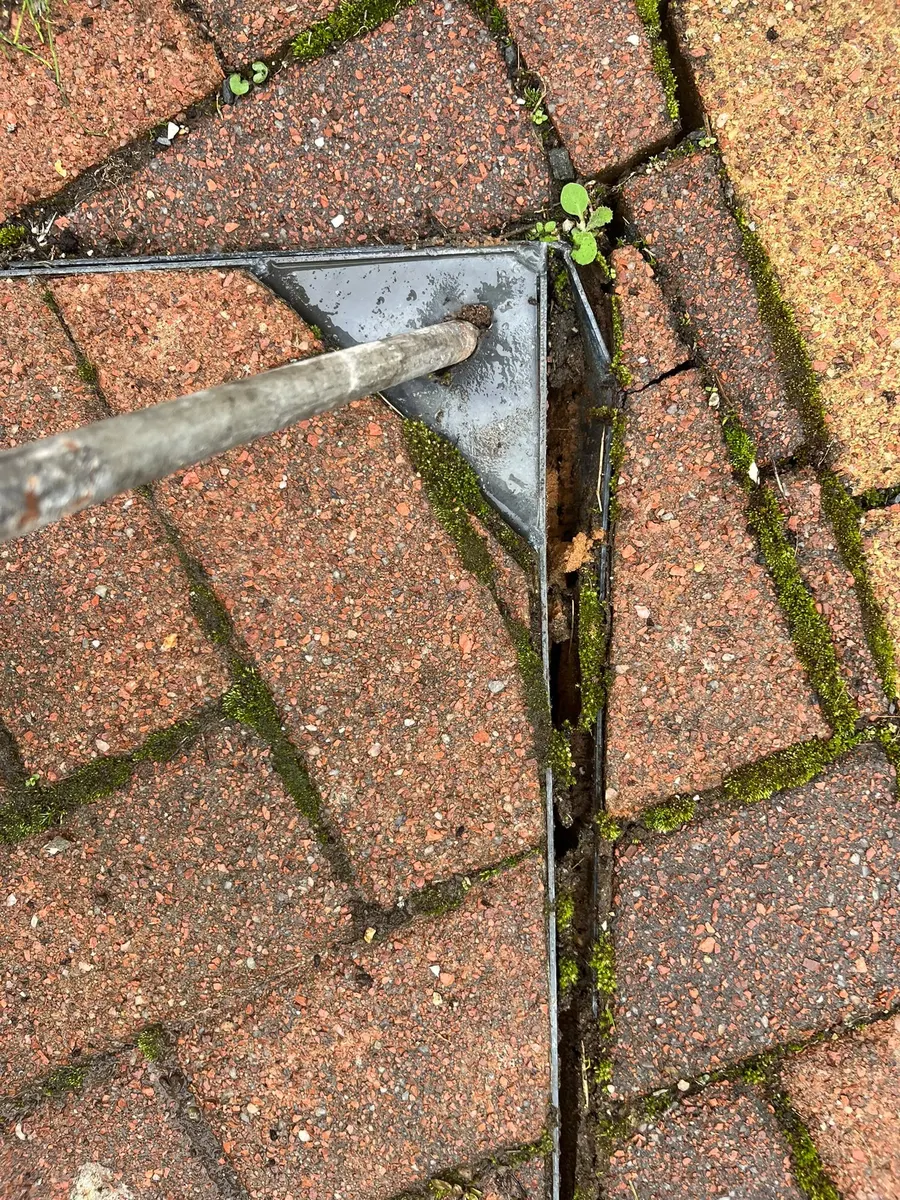
Follow the toilet's pipe with your eye. Find where the soil pipe or the bathroom waste enters the ground at the outside wall, then look along the line away from the house for a lid in the path, drive or lawn. A recessed cover on block paving needs a lifting key, as in the photograph below. A cover under gravel, decking, planters or soil is a job for a firm and not for a spade.
Lift the lid and look from above
Use a lifting key or a screwdriver in the slot and lift steadily. Lids are heavy and can crack, so if it will not come with a steady lift, leave it. Wear gloves, keep children and pets away, and look from standing height.
Do not climb in, and do not lean in far. The Health and Safety Executive's confined spaces guidance (INDG258) lists enclosed drains and sewers as confined spaces, lists open-topped chambers among the less obvious ones, and says that those killed in confined spaces include people who try to rescue others without training and equipment. The Scottish building standards handbook says health and safety law requires manual entry to a drain or sewer to be used only where no alternative exists, and that traditional inspection chambers are used for depths of up to 1m. If you cannot see the bottom of the chamber, it is deeper than that, and it is not a job to lean into.
Hygiene matters even from above. The HSE says Weil's disease, a form of leptospirosis, is caught from the urine of infected rats through cuts and scratches or through the mouth, throat and eyes, and that it is rare in the UK. Its controls are ordinary ones: gloves, regular hand washing, no hand to mouth or eye contact, and waterproof dressings over cuts.
Read the chamber against what the toilet is doing
The chamber tells you which stretch of pipe is blocked. The toilet's symptoms tell you whether the blockage is likely to sit upstream of the chamber, in the house pipework, or downstream, towards the boundary. The table below combines the two. It is our own reading, built from the full-or-empty rule and the Scottish boundary facts above, so treat it as a strong hint and not proof.
| Chamber nearest the house | Toilet and other fittings | What it usually means | What to do next |
|---|---|---|---|
| Full, water standing and not moving | Toilet slow, other fittings gurgle | The blockage is downstream of this chamber, further along towards the boundary | Lift the next chamber towards the boundary to narrow it down, then call |
| Dry or a clear trickle in the channel | Toilet blocked, plunging changed nothing | The blockage is between the chamber and the toilet, or in the toilet's own branch | Stop rodding at a hard stop. Call a drainage engineer with a camera |
| Dry or a clear trickle | Only that one toilet is slow | A pan, trap or short branch problem and not the main drain | Treat it at the pan, or ask about an internal unblock |
| Running freely, water moving | Still blocked | This stretch is clear. The blockage is on another branch or in the house pipework | Check the other chambers on the property and the other branch |
| The last chamber before the boundary is full | Neighbours report the same | The blockage may be in the public sewer, which is Scottish Water's | Ring Scottish Water and ask a firm to confirm which side with a camera |
| Sewage at ground level, a strong smell, or a chamber too deep to see the bottom | Any | A larger problem or a space with poor air | Keep away, do not lean in, and call |
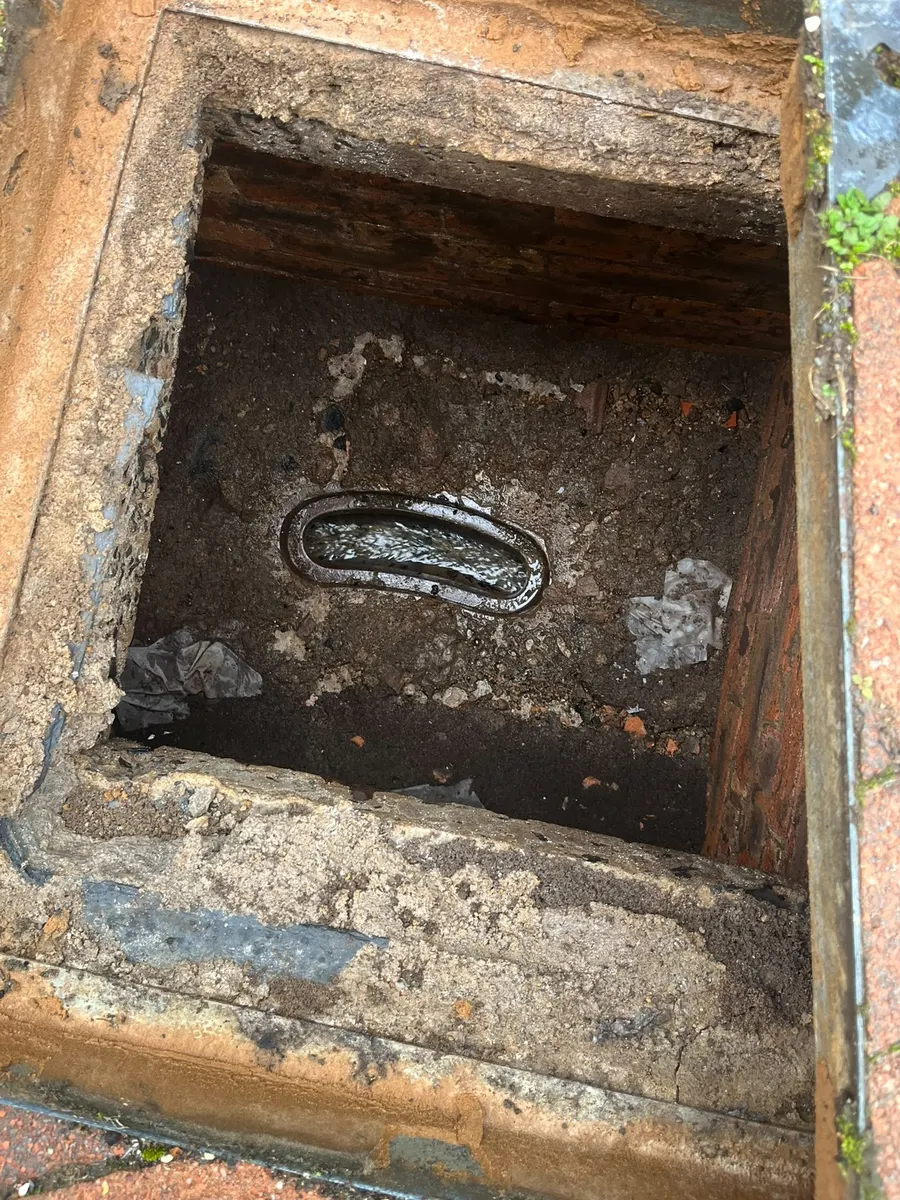
Here is the table at work on an example layout, not a real job. A house has two chambers: A just outside the downstairs toilet wall and B just inside the boundary. The downstairs toilet will not clear after plunging, and the bath gurgles when the basin runs. You lift both lids. A is full and B is dry.
- B is dry, so nothing is reaching it: the blockage is upstream of B.
- A is full, so water is held back at A: the blockage is downstream of A.
- Put the two together and it is in the single stretch between A and B. Only that stretch needs rods or a jetter, and the boundary and the public sewer are not involved.
Had both been full, the blockage would be past B, towards the boundary or the public sewer. Had A been dry, it would be between A and the toilet. Telling a firm "A full, B dry, bath gurgles" on the phone saves them guessing.
Where a householder should stop
Looking is safe. Clearing is not always. In our view, stop at the first of these.
- You are rodding and the rods meet a hard stop that does not move, or the level does not drop.
- The chamber is deeper than you can see the bottom of, or there is any smell that makes you want to step back.
- Sewage is on the ground or coming up through the lid.
- The toilet is the only one in the house and it is unusable, or it has blocked before.
The point of stopping is cost as well as safety. A stuck rod turns a small job into a bigger one, and a root or a break in the pipe will not rod clear. A drain that keeps coming back deserves a camera before a second clear-out.
When the chamber says it is not your drain
If the last chamber before the boundary is full and the neighbours are affected, the blockage may be in the public sewer. Scottish Water says it is responsible for the provision, operation and maintenance of the public sewer network. Its guide gives 0800 0778778 for reporting flooding that appears to be contaminated with sewage, and its Your pipes FAQ lists 0800 0778 778 as answered 24 hours a day, seven days a week. The same guide says there are over 36,000 blocked drains and sewers across Scotland every year, and that around 80% of those are caused by inappropriate items going down the toilet or by fat, oil and grease going down the sink. That is why the most common cause in the chamber is not exotic: look for wipes, nappy liners and wads of paper, and see our guide to drains blocked with wet wipes before blaming the pipe.
Two further points keep you out of trouble. A gully in the road is the council's business and not yours or Scottish Water's. And a drain shared by flats is a different case: Citizens Advice Scotland says owners are jointly responsible for shared pipes and that the rules on paying for repairs should be in the title deeds. Our guide to who is responsible for blocked drains in Scotland sets out the full definitions.
What it costs, with a worked sum
These are UK market ranges from two other sites, not CB Drainage prices. Fantastic Services' 2026 guide says its figures include VAT. MyJobQuote's page was last updated on 22 September 2026 and does not say whether its figures include VAT, so ask.
| Job | MyJobQuote, updated 22 September 2026, VAT not stated | Fantastic Services, 2026, including VAT |
|---|---|---|
| Unblock at the pan with a snake | £75 to £100 | Unclogging a toilet £30 to £75 (rest of UK) |
| Rod the outside drain | £100 to £150 | £60 to £90 (rest of UK) |
| Jet the outside drain | £150 to £175 | £70 to £125 (rest of UK) |
| Typical drain unblock, all in | Rodding and jetting together £150 to £200 | £80 to £250 (rest of UK) |
| Emergency call-out for a blocked toilet | £100 to £200 | Same-day, evening, weekend and bank-holiday call-outs carry a premium |
| Camera survey to find the cause | Not listed | Adds £90 to £200 |
Now the sum that reading the chamber saves. Suppose the toilet is unblocked at the pan first and the real blockage is in the drain, so the outside drain is then rodded as well. Using MyJobQuote's figures, that is £75 plus £100 at the low end, £175, and £100 plus £150 at the high end, £250. Going straight to rodding after the chamber reading costs £100 to £150. The pan visit was an extra £75 to £100 that the reading would have avoided.
VAT is the other sum. GOV.UK sets the standard rate at 20% and says a business must register once its taxable turnover passes £90,000, so a firm below that has no VAT to add. If a registered firm quotes £150 for rodding before VAT, VAT is £30 and the total is £180. Ask for the total including VAT, in writing.
What to send for a fixed quote
A short message with the following gets a firm to a number it can stand behind.
- A photograph of the open chamber from above, showing the water level, and which chamber it is (A or B in the example above).
- Which toilet, and which other fittings gurgle or are slow, and since when.
- Whether a neighbour is affected, and whether anything has been flushed that should not have been.
- Whether it has blocked before, and any trees or large shrubs near the run.
- Your town, so the firm can say whether it covers you. Brian covers Alloa, Falkirk and Stirling among other Central Scotland towns.
Then ask what the price covers: the method, whether a camera survey is included or extra, the call-out charge, VAT, and what happens if the blockage turns out to be a broken pipe that needs a repair quote.
Rods will not shift it?
Ask for the camera before a second visit
Call Brian or use the quote form, and ask for the method, the VAT position and the total in writing before work starts.
Request a quoteCall 07935 496833
Keeping it clear afterwards
Most of the prevention is on Scottish Water's list: only used water, pee, poo and toilet paper go down the toilet, and fat, oil and grease go in the bin. Keep the chamber lid findable, so the next reading takes a minute. A back-garden run with several chambers is covered in our guide to a blocked drain in the back garden, and the rest are in the advice hub. If you are weighing who to call first, see the drain unblocking page for what Brian does.
Blocked toilet and outside drain: common questions
How do I check the drain outside when my toilet is blocked?
Lift the inspection chamber lid nearest the house with a lifting key or screwdriver and look from above, without climbing in. Water standing in the channel means the blockage is further along towards the boundary. A dry channel means it is between that chamber and the toilet. Stop at a hard stop in the rods, a deep chamber or any sewage at ground level.
Is a blocked toilet drain outside my responsibility?
Usually yes. Scottish Water says the private drain runs from your home to your property boundary and that the homeowner is responsible for it. If you rent, tell your landlord first. Beyond the boundary the public sewer is Scottish Water's responsibility.
Is it safe to climb into an inspection chamber?
No. The HSE lists enclosed drains, sewers and open-topped chambers among confined spaces, and says those killed include people who tried to rescue others without training and equipment. The Scottish building standards handbook says manual entry to a drain should only happen where no alternative exists. Look from above.
What does it cost to unblock a toilet and its outside drain?
MyJobQuote's page, updated 22 September 2026, gives £75 to £100 for clearing at the pan and £100 to £150 for rodding the outside drain, and does not say whether VAT is included. Fantastic Services' 2026 guide, including VAT, gives £80 to £250 for a typical drain unblock. These are market ranges, not CB Drainage prices.
Who do I call if the chamber is full and my neighbours are affected?
The blockage may be in the public sewer, which Scottish Water maintains. Its guide gives 0800 0778778 for reporting flooding that appears to be contaminated with sewage. A camera survey from a drainage engineer can confirm which side of the boundary the blockage is on.
Sources
- Scottish Water: A guide to drains and sewers, for the four inch drain, the 36,000 blockages a year and 80% figure, and the sewage flooding report number. Checked 4 November 2026.
- Scottish Water: Your pipes FAQ, for who owns the private drain and the public sewer. Checked 4 November 2026.
- Scottish Government: Building standards technical handbook 2022, domestic, 3.7 Wastewater drainage, for the disconnecting inspecting chamber inside the curtilage, the 1m chamber depth and the rule on manual entry. Checked 4 November 2026.
- Citizens Advice Scotland: Public sewerage, for who maintains public sewers, who pays for a private blockage and shared pipes. Checked 4 November 2026.
- Health and Safety Executive: Confined spaces, a brief guide to working safely (INDG258), for drains, sewers and open-topped chambers as confined spaces and the risk to rescuers. Checked 4 November 2026.
- Health and Safety Executive: Leptospirosis / Weil's disease, for how it is caught and the hygiene controls. Checked 4 November 2026.
- MyJobQuote: Cost of unblocking a toilet, last updated 22 September 2026, for the pan, rodding, jetting and emergency ranges. Checked 4 November 2026.
- Fantastic Services: How much does it cost to unblock a drain? (2026 UK price guide), for the ranges including VAT and the camera survey figure. Checked 4 November 2026.
- GOV.UK: VAT rates and GOV.UK: When to register for VAT, for the 20% rate and the £90,000 threshold. Checked 4 November 2026.