
A blocked drain in the back garden is normally your own private drain, so it is yours to deal with (if you rent, tell your landlord first). The quickest way to find the blockage is to lift the nearest inspection chamber lid and look from above, without climbing in. Water standing in the chamber means the blockage is further along the run, towards the boundary. An empty chamber means it is between that chamber and the house. A 2026 UK price guide puts a typical drain unblock at £80 to £250 including VAT, and a camera survey adds £90 to £200, so a minute at the lid is worth it before anyone is booked. This guide covers what usually blocks a garden drain, how to find a chamber buried under gravel or turf, how to read it with a worked three-chamber example, where a householder should stop, and what a fair quote lists. If you would rather hand it over, our drain unblocking service covers Alloa, Falkirk, Stirling and the rest of Central Scotland.
Whose drain is it in the back garden?
Scottish Water says the private drain runs from your home to your property boundary, where it meets the public sewer, and that the homeowner is responsible for it. Citizens Advice Scotland puts the other side the same way: homeowners and landlords are responsible for household waste pipes up to where they connect with the public sewer, and Scottish Water maintains public sewers from that point. So a chamber in your own back garden, serving your own house, is on the private side, and the clearing is paid for by you or your landlord.
Two cases are different. Scottish Water's guide says a drain that leaves your curtilage, or joins drains from another property's curtilage, becomes a public sewer, while the common drainage inside one curtilage, such as a block of flats, stays private. If you rent, the first call is your landlord, and our guide to landlord or tenant to pay sets out the Scottish rules. The full definitions are in our guide to who is responsible for blocked drains in Scotland, and our outside-the-house cost guide sorts the five places an outside blockage can be.
What usually blocks a garden drain
Scottish Water says the drain from a house to the public sewer is usually about four inches wide, built for used water from sinks, showers and baths plus pee, poo and toilet paper, and that around 80% of blockages are caused by the wrong items going down the toilet or by fat, oil and grease going down the sink. Fantastic Services' 2026 guide lists fat and grease, hair, food waste, wet wipes and tree roots. Stirling Council adds that falling leaves can be a major cause in autumn.
- Fat and grease from the kitchen. Scottish Water groups it with flushed items as the cause of around 80% of blockages.
- Wipes and other flushed items. Our guide to drains blocked with wet wipes explains why a pack labelled flushable is still a blockage risk.
- Leaves and silt at the downpipe gully. This one is on the surface and often safe to clear yourself. Our blocked gully guide shows how.
- Tree roots and a damaged pipe. Fantastic Services lists roots among the common causes and says a collapsed or root-damaged pipe needs repair, which can mean excavation. Roots and breaks are what a camera survey is for.
The cause changes the fix. A root or a broken pipe will block again unless it is found and repaired, so a drain that keeps coming back deserves a camera before a second clear-out.
Start at the back wall
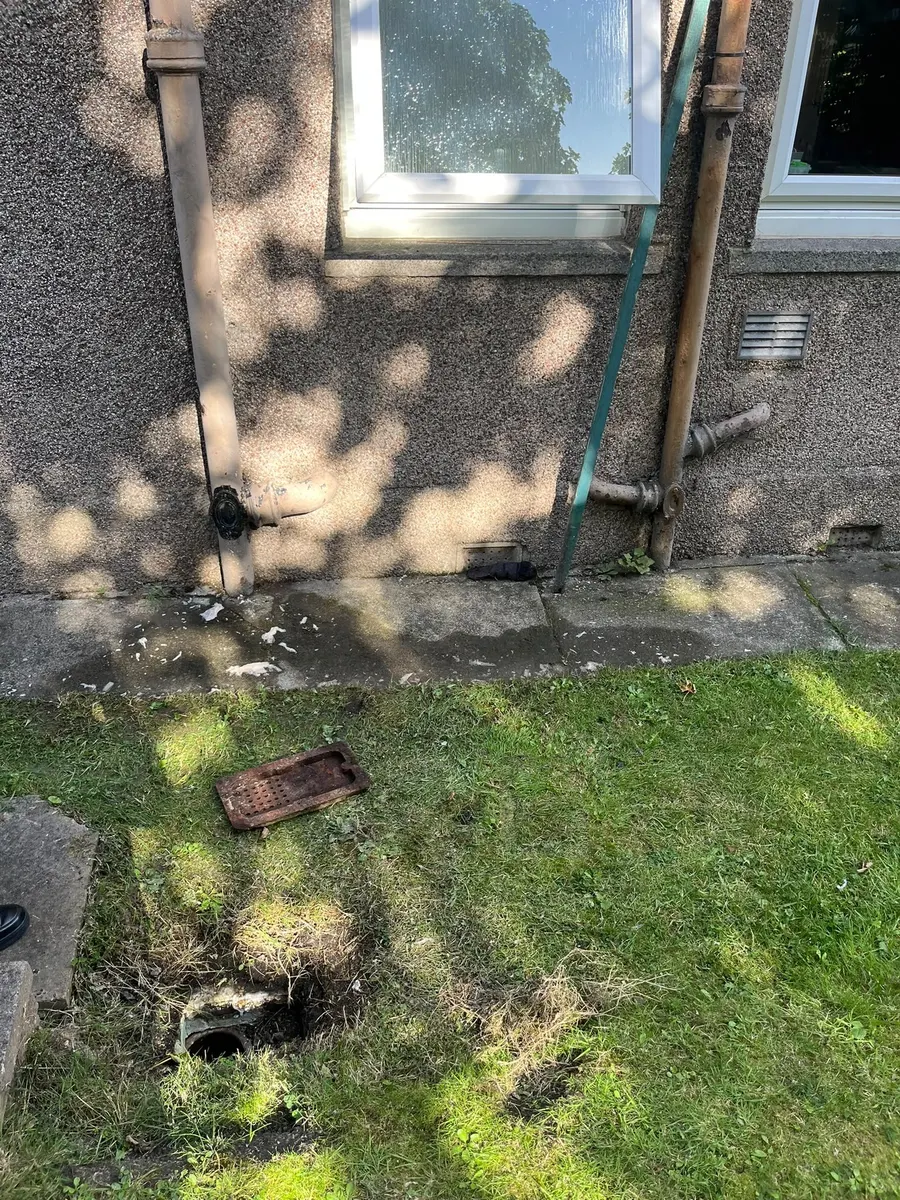
Every run into the garden starts somewhere you can see. Look at the foot of each downpipe, and at the soil pipe and kitchen waste where they go into the ground. If a gully grate is full of leaves or silt, clear it with gloves on. If the gully is clear and water is still standing in the garden, the problem is further along the run, and the next stop is the nearest inspection chamber.
Find the inspection chamber
The Scottish building standards technical handbook (2022 edition, domestic, section 3.7.4) says that where a private drain meets a public sewer, normally at the curtilage, some form of access should be provided, and that the preferred method is a disconnecting inspecting chamber for each house immediately inside the curtilage. Scottish Water's own diagram of a typical property labels a disconnecting chamber on the homeowner's private drain. The handbook calls that the preferred method and says other methods and locations may be acceptable, and Scottish Water notes that its example layouts are typically historical, so an older house may differ. As a rule, expect at least one chamber near the boundary and others where runs join or turn.
- Follow the pipes out from the wall.
Take each ground entry at the back wall and look along the line towards the boundary. Chambers sit on those lines.
- Look for a lid, or for something that looks like one.
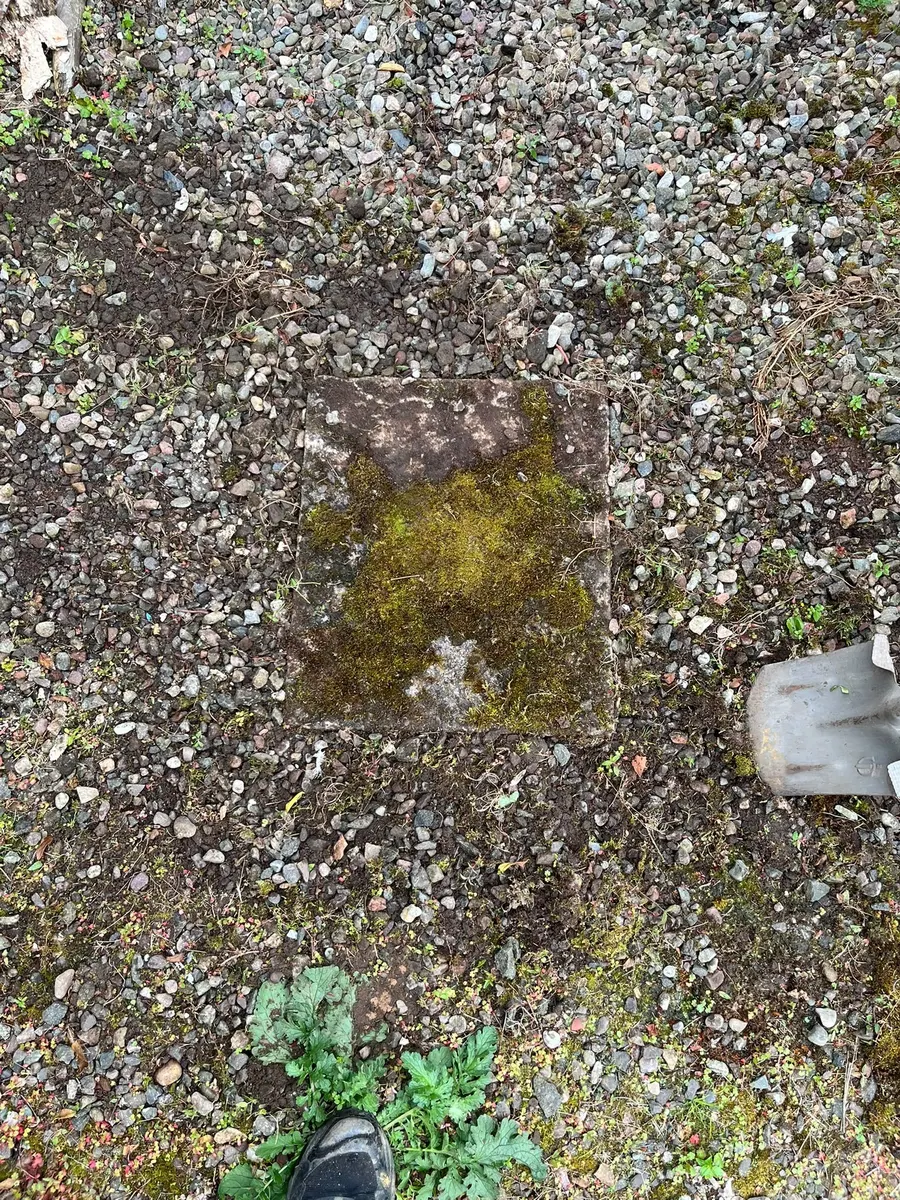
A square or round cover in the lawn, a path or the drive is the easy case. A slab that sits slightly apart from the paving, or a patch of gravel or turf at a different level, can be a buried lid.
- Scrape back, do not dig.
A little gravel or turf over a lid is a job for a trowel. If the lid is under decking, planters, soil or more than a scrape of cover, stop and let a firm find and open it.
- Lift it carefully.
Speedy Hire's guide says to use a lifting tool or a screwdriver. Lids are heavy and can crack, so if it will not come up with a steady lift, leave it for a firm.
Read the chamber: full, empty or flowing
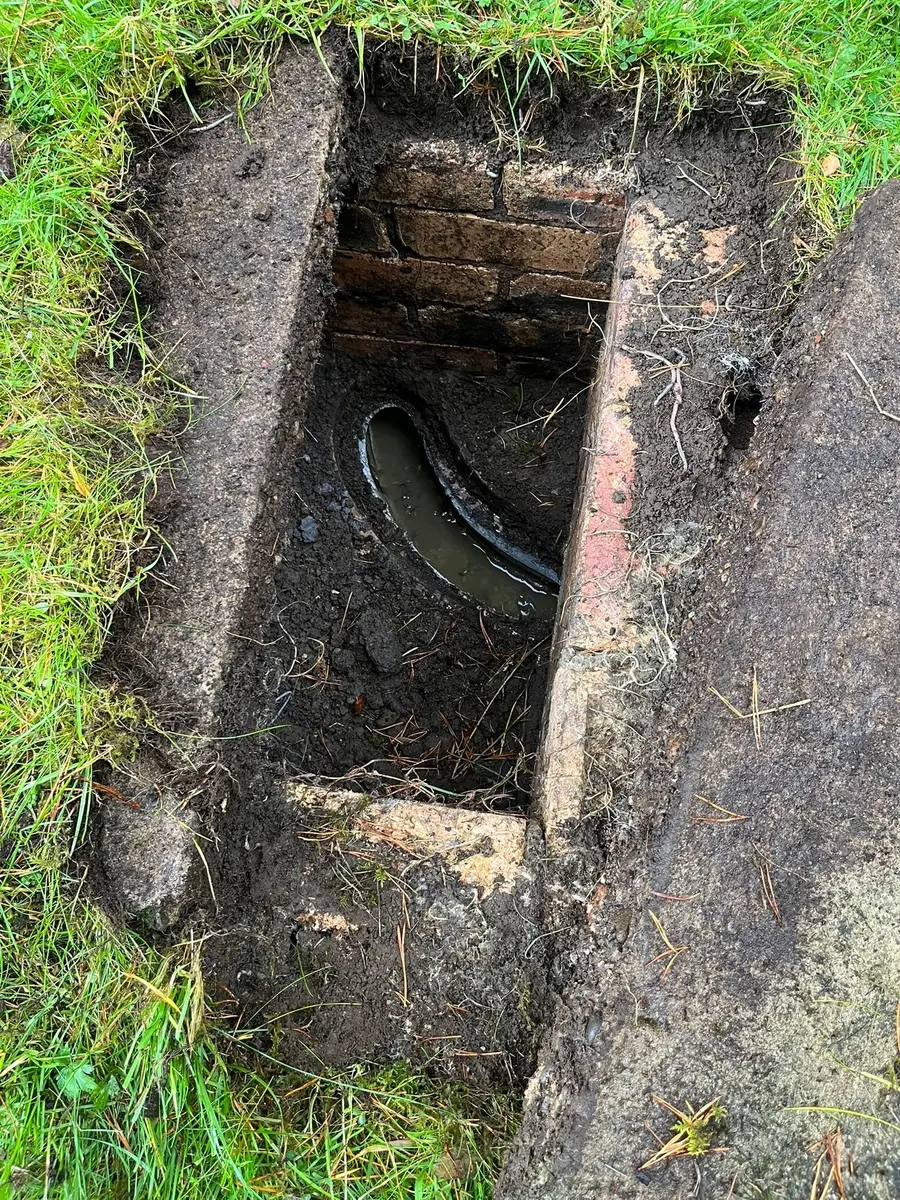
The Speedy Hire guide gives the basic rule: if water is standing in the chamber, the blockage is likely downstream of it, and if the chamber is empty, the blockage is between the chamber and the house. That is a strong hint and not proof. The table below extends it to a run of chambers and says what to do next. It is our own rule of thumb, built from that rule and the Scottish boundary facts above.
| What you see in the chamber | What it usually means | What to do next |
|---|---|---|
| Empty, or a clear trickle in the channel, while the sink or toilet is still slow | The blockage is upstream of this chamber, between it and the house, or inside the house pipework | Lift the next chamber towards the house. If there is none, call a drainage engineer |
| Full, with water standing and not moving | The blockage is downstream, further along the run towards the boundary | Lift the next chamber towards the boundary to narrow it down |
| The channel is running freely and the water is moving | This stretch is clear. The blockage is on another branch or further on | Check the other chambers, and any other branch from the house |
| The last chamber before the boundary is full | The blockage is in the short length to the boundary, or in the public sewer beyond it | If neighbours are affected or sewage is in the street, ring Scottish Water. A camera survey settles which side it is |
| Sewage in the garden, a strong smell, or a deep chamber where you cannot see the bottom | A larger problem, or a space with poor air | Keep away, do not lean in, and call. Scottish Water takes reports of sewage flooding on 0800 0778 778 |
Here is the table at work on an example layout, not a real job. A house has three chambers down the garden: A by the back wall, B halfway down and C just inside the boundary. The kitchen sink is slow and the toilet gurgles when the washing machine runs. You lift all three lids. A is full, B is full and C is empty.
- C is empty, so nothing is reaching it: the blockage is upstream of C.
- B is full, so water is held back at B: the blockage is downstream of B.
- Put the two together and the blockage is in the one stretch between B and C. Only that stretch needs rods or a jetter.
Had A been full and B empty, the stretch would be between A and B. Had all three been full, the blockage is past C. Telling a firm "A and B full, C empty" on the phone saves them guessing.
What you can safely do, and where to stop
What you can safely do is mostly looking. Lift the lid from the surface, read the chamber, take a photograph from above and note which fittings are slow. Stop putting fat down the sink, and clear leaves off a gully grate with gloves on.
Do not climb into a chamber, and do not lean in far. The Health and Safety Executive's guidance on confined spaces, written for employers, lists enclosed drains and sewers among them. It says poisonous gas can build up in sewers and manholes, and that those killed in confined spaces include people who try to rescue them without training and equipment. The Scottish building standards handbook (section 3.7.3) says manual entry to a drain or sewer should only happen where no alternative exists, and that remotely operated equipment is the normal way in. If trained firms avoid going in, a householder should too.
Hygiene matters even from above. The HSE says Weil's disease, a form of leptospirosis, is caught from the urine of infected rats through cuts and scratches or through the mouth, throat and eyes, and that it is rare in the UK. Its controls are the ordinary ones: gloves, regular hand washing, no hand to mouth or eye contact, and covered cuts.
Rodding is the grey area. Hire-shop guides such as Speedy Hire's describe it, and the one tip worth repeating is to turn the rods clockwise only, because turning them the other way can unscrew a joint and leave a rod stuck in the pipe. In our view, if the rods meet a hard stop that does not move, or the water level does not drop, that is the stopping point. A stuck rod turns a small job into a bigger call-out, and a root or a break will not rod clear anyway.
When the blockage is not in your garden
If the last chamber is full and your neighbours' drains are slow too, the blockage may be in the public sewer, which Scottish Water maintains. Its helpline is 0800 0778 778, open at all hours. A gully in the road is the council's, not yours or Scottish Water's, and our guide on the blocked gully outside covers the council routes.
Be careful with chamber advice written for another country. Several popular chamber guides present English and Welsh building rules as if they apply across the UK, and some say that since 2011 many shared drains have been adopted by the water companies. That transfer happened in England and Wales. Scotland never had it, and chamber design here follows section 3.7 of the Scottish handbook, so a guide written for England can send you to the wrong body. Our guide to whether Scottish Water will unblock your drain shows what it does and does not cover.
What clearing a garden drain costs, with a worked sum
These are UK market ranges from two other sites, not CB Drainage prices. Fantastic Services' 2026 guide gives figures that include VAT. MyJobQuote's page was last updated on 22 September 2026 and does not say whether its figures include VAT, so ask.
| Job | Fantastic Services, 2026, including VAT | MyJobQuote, updated 22 September 2026 |
|---|---|---|
| Rod an outside drain | £60 to £90 | £100 to £150 |
| Jet an outside drain | £70 to £125 | £150 to £175 |
| Typical drain unblock, all in | £80 to £250 | £150 to £200 for rodding and jetting together |
| Camera survey | Adds £90 to £200 | £90 to £500 for repeat blockages |
| Blockage needing excavation | From about £600 | Not listed |
Two sums show where the money goes. GOV.UK sets the standard rate at 20% and says a business must register once its taxable turnover passes £90,000, so a firm below that has no VAT to add. If a firm is registered and quotes £150 for jetting plus £150 for a camera survey before VAT, that is £300, VAT is £60 and the total is £360. Ask for the total including VAT, in writing.
Next, the camera against digging blind. Fantastic Services puts a camera survey at £90 to £200 and a job needing excavation from about £600, both including VAT. The survey is £90 ÷ £600 = 15% up to £200 ÷ £600 = about 33% of that minimum dig cost. When a drain keeps blocking and roots or a break are suspected, paying for the camera first means the digging, if it comes, is in the right place.
What to send for a fixed quote
A short message with the following gets a firm to a number it can stand behind.
- A photograph of the open chamber from above, showing the water level, and the chamber you read it from (A, B or C in the example above).
- Which fittings are slow or gurgling, and since when.
- Whether a neighbour is affected, and whether anything has been flushed or poured down that should not have been.
- Any trees or large shrubs near the run, and whether the drain has blocked before.
- Your town, so the firm can say whether it covers you. Brian covers Alloa, Falkirk and Stirling among other Central Scotland towns.
Then ask what the price covers: the method, whether a camera survey is included or extra, the call-out charge, VAT, and what happens if the blockage is a broken pipe that needs a repair quote.
Rods will not shift it?
Ask for the camera first
Call Brian or use the quote form, and ask for the method, the VAT position and the total in writing before work starts.
Request a quoteCall 07935 496833Keeping it clear afterwards
Most of the prevention is on Scottish Water's list: only used water, pee, poo and toilet paper go down, and fat, oil and grease go in the bin. Fantastic Services adds a sink strainer and clearing a slow drain early. Keep a chamber lid findable, so the next reading takes a minute. For who to call, see whether plumbers unblock drains, the toilet unblocking cost guide and our Stirling and Falkirk price guide. The rest are in the advice hub.
Keep reading: blocked toilet drain outside: how to check the chamber.
Blocked drain in the garden: common questions
Whose responsibility is a blocked drain in my back garden?
Usually yours. Scottish Water says the private drain runs from your home to your property boundary and that the homeowner is responsible for it. If you rent, tell your landlord first. A drain that leaves your boundary, or joins another property's, becomes a public sewer, which is Scottish Water's.
How do I find the inspection chamber in my garden?
Follow the pipes out from the back wall and look for a lid in the lawn, path or drive, or a slab or patch of gravel that sits out of line. The Scottish building standards handbook prefers a chamber just inside the boundary for each house, so expect one near it. If the lid is under decking or soil, let a firm open it.
What does it mean if the inspection chamber is full of water?
A hire-shop drain rod guide says standing water in the chamber means the blockage is likely downstream of it, and an empty chamber means it is between the chamber and the house. It is a strong hint and not proof, so read the other chambers too, and use a camera survey if it is unclear.
Can I rod a blocked garden drain myself?
Some householders do, but never climb into the chamber. If you rod, turn the rods clockwise only so the joints do not unscrew, and stop if they meet a hard stop or the water does not drop. A root or a broken pipe will not rod clear, so a drain that keeps blocking needs a camera.
How much does it cost to clear a blocked drain in the garden?
Fantastic Services' 2026 guide puts a typical drain unblock at £80 to £250 including VAT, with a camera survey adding £90 to £200 and excavation from about £600. MyJobQuote, updated 22 September 2026, gives £100 to £150 for rodding and £150 to £175 for jetting. These are market ranges, not CB Drainage prices.
Sources
- Scottish Water: A guide to drains and sewers, for the curtilage and flats rule, the labelled disconnecting chamber, the four inch drain, the 80% blockage figure and the sewage flooding helpline. Checked 30 October 2026.
- Scottish Water: Your pipes FAQ, for who owns the private drain and the public sewer, and the report line. Checked 30 October 2026.
- Scottish Government: Building standards technical handbook 2022, domestic, 3.7 Wastewater drainage, for the disconnecting inspecting chamber just inside the curtilage and the rule on manual entry. Checked 30 October 2026.
- Citizens Advice Scotland: Public sewerage, for who maintains public sewers and who pays for a private blockage. Checked 30 October 2026.
- Health and Safety Executive: Confined spaces, a brief guide to working safely (INDG258), for drains and sewers as confined spaces, gas in manholes and the risk to rescuers. Checked 30 October 2026.
- Health and Safety Executive: Leptospirosis / Weil's disease, for how it is caught and the hygiene controls. Checked 30 October 2026.
- Stirling Council: Report a blocked or broken drain, for falling leaves as a cause of blocked drains in autumn. Checked 30 October 2026.
- Speedy Hire: How to clear a blocked drain using drain rods, for the full or empty chamber rule, the lifting tool and turning rods clockwise. Checked 30 October 2026.
- Fantastic Services: How much does it cost to unblock a drain? (2026 UK price guide), for common causes, the market ranges including VAT and the camera survey and excavation figures. Checked 30 October 2026.
- MyJobQuote: Cost of unblocking a toilet, last updated 22 September 2026, for the rodding, jetting and camera survey ranges. Checked 30 October 2026.
- GOV.UK: VAT rates and GOV.UK: When to register for VAT, for the 20% rate and the £90,000 threshold. Checked 30 October 2026.